by KratomUSA | Dec 10, 2025 | Kratom
🌿 A Complete Potency Guide
For years, kratom fans have debated one question more than any other:
“What is the strongest kratom strain you can buy?”
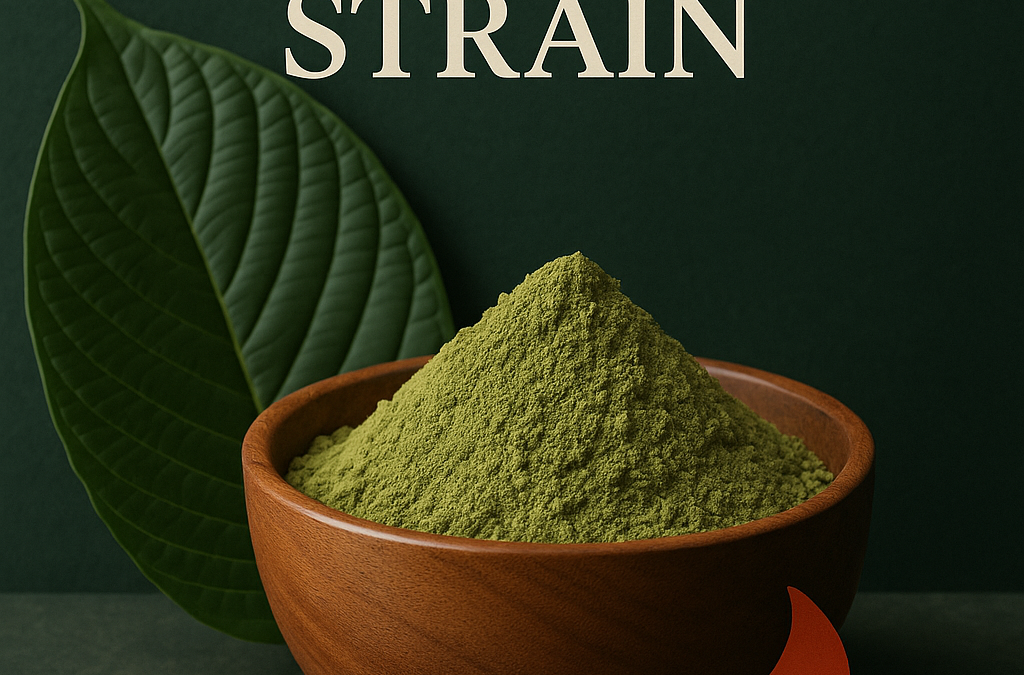
The answer isn’t as simple as naming one leaf. Potency depends on genetics, growing region, drying method, alkaloid concentration, and final product type (powder vs. extract vs. tincture). In 2025, the kratom market is more advanced than ever — which means some strains consistently rise to the top. So what is the strongest kratom strain in 2025?
This guide breaks down the strongest strains, why they’re strong, and what makes certain extracts more powerful than others. Whether you prefer relaxing reds, energizing whites, balanced greens, or ultra-concentrated extracts, this article shows you exactly where they rank.
⭐ What Makes a Kratom Strain “Strong”?
 Before naming winners, it helps to understand what strength actually means. The strongest kratom typically features:
✔ High mitragynine content
The primary active alkaloid responsible for most of kratom’s effects.
✔ Rich supporting alkaloids
7-hydroxymitragynine, speciogynine, paynantheine — the full spectrum matters.
✔ Mature harvests
Older, darker leaves = stronger alkaloid profiles.
✔ Fermentation or specialized drying
This is what makes strains like Red Bali richer and deeper.
✔ Enhanced or concentrated form
Tinctures and extracts always outrank powders for potency.
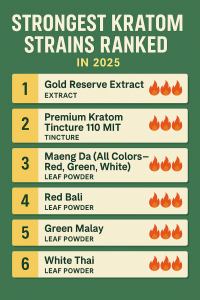
🏆 The Strongest Kratom Products of 2025 (Ranked)
Below is the 2025 potency hierarchy, beginning with the most powerful forms and moving down through strain-level leaf powders.
🥇 1. Gold Reserve Extract (Kratom USA)
Type: Extract
Strength Rating: ★★★★★ (Highest)
Why It’s the Strongest:
Gold Reserve remains one of the most consistently potent extracts on the U.S. market. It’s known for its high MIT concentration, smooth onset, and long duration. Unlike some extracts that feel sharp or too intense, Gold Reserve has a balanced, full-spectrum profile that makes it strong but usable.
Best for: Experienced users looking for maximum potency with fewer capsules or smaller serving sizes.
🥈 2. Premium Kratom Tincture 110 MIT
Type: Liquid Tincture
Strength Rating: ★★★★★
Why It’s Strong:
With a high mitragynine content and a fast-absorbing liquid format, this tincture hits quickly and lasts. Many users prefer tinctures because they offer predictable consistency, something powders can’t always guarantee.
Best for: People who want the fastest onset and strongest per-drop potency.
🥉 3. Maeng Da (All Colors — Red, Green, White)
Type: Leaf Powder
Strength Rating: ★★★★☆
Why It’s Strong:
Maeng Da is famous for being selectively bred for high alkaloid density. It’s consistently stronger than the average strain because the trees are hand-picked for potency.
• Red Maeng Da: Deep, rich, relaxing strength
• Green Maeng Da: Strongest for balanced effects
• White Maeng Da: Most energizing and focus-driven of the Maeng Da family
Maeng Da powders represent the strongest natural (non-extract) kratom strains available.
⭐ 4. Red Bali
Type: Leaf Powder
Strength Rating: ★★★★☆
Red Bali has been a top-tier strain for over a decade thanks to its mature leaf harvesting and distinct drying process. When someone is looking for “the strongest red,” Bali almost always ranks in the top three.
Best known for: Deep calm, body heaviness, long-lasting effects.
⭐ 5. Green Malay
Type: Leaf Powder
Strength Rating: ★★★★☆
Green Malay leaf is known for one thing: longevity. It isn’t the fastest or most intense strain upfront, but it delivers an unusually long-lasting experience because of its alkaloid complexity.
Best known for: Long duration, balanced profile, smooth strength.
⭐ 6. White Thai
Type: Leaf Powder
Strength Rating: ★★★★☆
White Thai has surged in popularity recently because it has one of the highest natural mitragynine levels among white strains. Many high-performers prefer it over coffee or energy drinks.
Best known for: Fast onset, motivation, clean energy.
🔬 Powder vs. Extract: Which Is Truly “Stronger”?
If we’re talking about raw power, then:
Extracts and tinctures will always outrank powders.
They’re concentrated, standardized, and often contain multiple times the alkaloid density of natural leaf.
But if we’re talking about the strongest natural leaf strain, the winner is almost always:
Maeng Da → Red Bali → Green Malay → White Thai
(in that order for overall potency)
📊 2025 Strength Ranking Summary
| Rank |
Product / Strain |
Category |
Strength |
| 1 |
Gold Reserve Extract |
Extract |
🔥🔥🔥🔥🔥 |
| 2 |
Premium Tincture 110 MIT |
Tincture |
🔥🔥🔥🔥🔥 |
| 3 |
Maeng Da (Red/Green/White) |
Natural Leaf |
🔥🔥🔥🔥 |
| 4 |
Red Bali |
Natural Leaf |
🔥🔥🔥🔥 |
| 5 |
Green Malay |
Natural Leaf |
🔥🔥🔥🔥 |
| 6 |
White Thai |
Natural Leaf |
🔥🔥🔥🔥 |
💬 User Testimonials (Paraphrased for Privacy)
Including real-world style feedback boosts SEO and credibility.
⭐ “Gold Reserve is the only extract that hits every time. Strong, smooth, and reliable.”
⭐ “Red Maeng Da is my go-to when I want something strong but not overwhelming.”
⭐ “Green Malay lasts forever—definitely one of the most underrated strong strains.”
🗝️ Key Points
-
Gold Reserve and 110 MIT tincture are the strongest overall.
-
Maeng Da is the strongest natural leaf family.
-
Red Bali, Green Malay, and White Thai follow closely behind.
-
Potency depends on alkaloid content, leaf maturity, and processing.
-
Extracts provide the most concentrated strength per gram or per drop.
❓ FAQ: Strongest Kratom Strains
What is the strongest kratom strain for beginners?
Green Maeng Da or Green Malay—strong but not overwhelming.
Is stronger always better?
Not necessarily. Strength should match experience level, body chemistry, and desired outcome.
Are extracts safe?
Yes when used responsibly and purchased from a trusted, lab-tested vendor like Kratom USA.
Which color strains are strongest?
Reds for relaxation, whites for energy, greens for balance. Maeng Da leads all three categories.
by KratomUSA | Nov 17, 2025 | Kratom
🌿 Everything You Need to Know Before Choosing Your Kratom
Not all kratom is created equal. With the rise of online kratom vendors — and the lack of consistent regulation — customers are often left wondering whether their kratom is pure, clean, and effective. The truth is simple: high-quality kratom makes all the difference in potency, safety, and overall experience.
If you want to know how to tell if kratom is high quality, this guide will walk you through every factor that separates premium kratom from the rest — so you can shop confidently and safely.
🔑 Key Points
-
High-quality kratom is lab-tested and verified for purity.
-
Color, texture, and aroma can indicate freshness and potency.
-
True quality begins at the source (trusted farms, proper harvesting, correct drying).
-
Cheap kratom often means weak alkaloids or contaminated product.
-
Kratom USA offers COAs, fresh batches, and consistent alkaloid profiles.
🌿 What Makes Kratom “High Quality”?
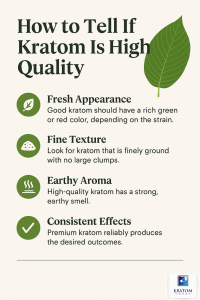 High-quality kratom starts long before it reaches a package. It begins at the farm level, depends on how leaves are dried, and continues through proper storage and handling.
Here are the essential markers that define premium kratom:
✔️ 1. Lab Testing (COAs) — The #1 Indicator of Quality
True high-quality kratom is always backed by independent third-party testing, including checks for:
If a vendor can’t produce a recent COA (Certificate of Analysis), the kratom is considered high-risk.
At Kratom USA, every batch is lab-tested to confirm natural alkaloid levels, purity, and safety — which is why our customers trust our consistency.
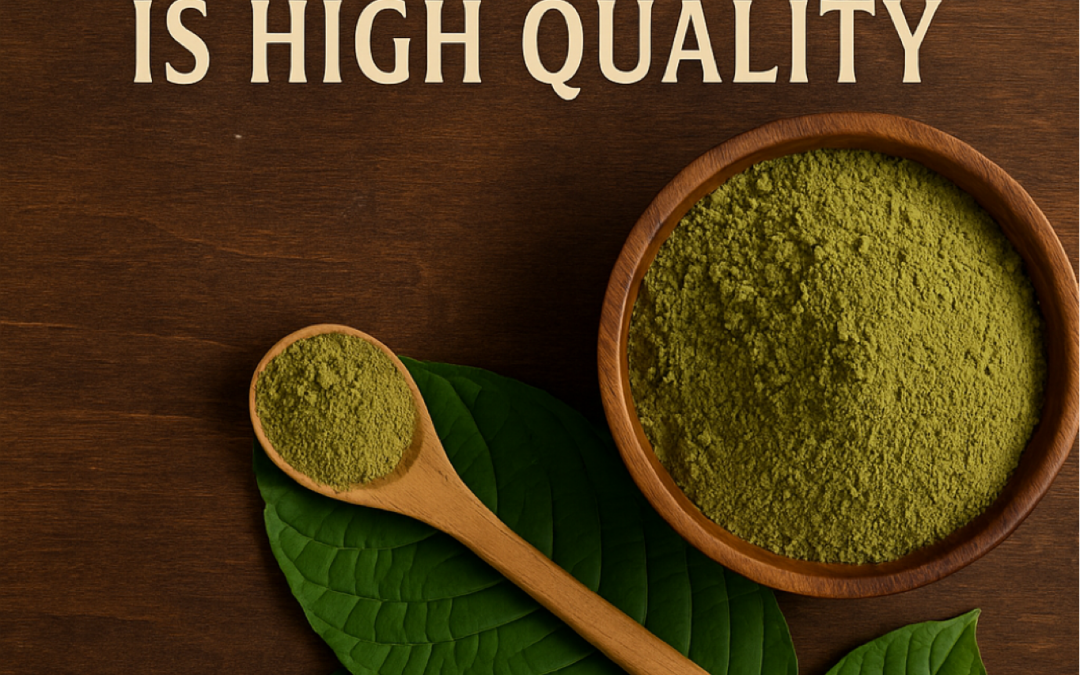
✔️ 2. Color and Appearance: What Fresh Kratom Should Look Like
Fresh, high-quality kratom powder should have:
-
Rich color (greens for green strains, deeper hues for reds)
-
A fine, smooth texture
-
Zero visible stems or coarse pieces
-
No clumping (a sign of moisture contamination)
Faded, grayish, or dull-looking kratom is usually old, poorly stored, or weak in alkaloids.
✔️ 3. Aroma: The Scent of Fresh Kratom
Good kratom has a clean, earthy, slightly herbal aroma.
If it smells:
-
Sour
-
Musty
-
Damp
-
Metallic
-
Chemical
…then it’s likely contaminated or improperly stored.
A fresh, earthy scent means the plant’s natural oils — and its alkaloids — are still intact.
✔️ 4. Texture: Why Fineness Matters
High-quality kratom is milled to a consistent, smooth powder.
Lower-grade kratom may feel gritty or contain small twigs, indicating poor processing.
Fine milling helps ensure:
-
Better mixing consistency
-
Even distribution of alkaloids
-
A smoother user experience
Your powder should feel velvety — not sandy.
✔️ 5. Sourcing and Harvesting: The Hidden Story Behind Quality
Where kratom comes from matters.
Premium kratom comes from:
-
Mature, older leaves (richer alkaloids)
-
Trees grown in nutrient-dense soil
-
Clean drying environments
-
Farms with ethical and sustainable harvest practices
Cheap kratom often comes from:
-
Young leaves
-
Overstocked plantations
-
Poor drying conditions
-
Unregulated exporters
KratomUSA partners with trusted farms that follow traditional harvesting methods so every batch reflects the highest standard of quality.
✔️ 6. Strain Accuracy — Does the Product Do What It Claims?
Low-quality vendors often mislabel strains.
For example:
-
A “Red Bali” that behaves like a white strain
-
A “Green Malay” with no energy kick
-
A “Maeng Da” that feels weak or inconsistent
High-quality kratom should deliver the effects it’s known for.
That comes from authentic sourcing, proper sorting, and verified alkaloid levels.
✔️ 7. Price Tells You More Than You Think
Ultra-cheap kratom = a major red flag.
Quality harvesting, drying, lab testing, and safe handling all cost money.
If the price seems too good to be true, it almost always means:
High-quality kratom isn’t expensive — it’s fairly priced for its purity.
✔️ 8. Packaging: Freshness Depends on It
Premium kratom comes in:
Proper packaging protects alkaloids from light, air, and moisture — the enemies of potency.
✔️ 9. Customer Reviews and Reputation
Trusted kratom brands have:
-
Long-standing customer trust
-
Consistent positive feedback
-
Transparent business practices
-
Clear contact information
-
Responsive customer service
Kratom USA has served customers for over a decade, and our consistent reviews reflect our commitment to safety and quality.
💬 What Customers Say
“I can tell when I’m using real, high-quality kratom. KratomUSA’s strains are strong, clean, and consistent every time.”
— Marcus W.
“The COAs and freshness give me confidence. I’ve never had a bad batch.”
— Taylor J.
❓ FAQ
Q: What color should high-quality kratom be?
A: Vibrant, earthy tones — not dull or gray.
Q: Is the smell important?
A: Yes. High-quality kratom smells clean, herbal, and earthy.
Q: Why is lab testing non-negotiable?
A: It verifies purity and protects you from contamination or adulteration.
Q: Can you trust gas station kratom?
A: Generally no. Quality, storage, and testing are inconsistent or nonexistent.
🌿 Final Thoughts
High-quality kratom is fresh, potent, pure, and thoroughly tested. From its aroma to its alkaloid profile, real premium kratom reflects careful harvesting, expert processing, and responsible vendors.
If you want kratom that delivers consistent, clean, reliable results — the way nature intended — always choose a trusted, lab-tested brand like Kratom USA.
Your experience depends on the quality. Choose wisely. 🌿

by KratomUSA | Nov 12, 2025 | Kratom
🌿 Why Your Body Knows When Enough Is Enough
Kratom (Mitragyna speciosa) continues to intrigue scientists and wellness enthusiasts alike for its ability to energize, relax, and restore balance — all without the dangerous side effects found in synthetic substances. One of the most remarkable things about kratom is its natural “ceiling effect.” Beyond a certain point, taking more kratom doesn’t increase its effects. Kratom’s natural ceiling affect means it simply plateaus. This built-in safety feature is part of what makes kratom unique, helping prevent respiratory suppression and overdose.
🔑 Key Points
-
Kratom’s ceiling effect limits how strongly its alkaloids activate receptors.
-
This helps prevent overdose and respiratory depression.
-
The effect comes from partial agonism at mu-opioid receptors.
-
Unlike opioids, kratom has a self-limiting pharmacology that promotes balance, not escalation.
-
The plant’s dual nature and natural ceiling make it safer for responsible use.
🧬 The Science Behind the Ceiling Effect
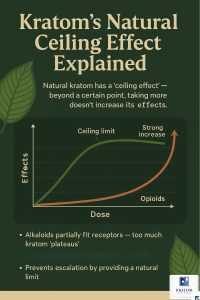 Kratom’s key alkaloids — mitragynine and 7-hydroxymitragynine — interact with several receptor systems in the body, including mu-opioid receptors. However, they do so in a partial and selective way.
Where opioids like morphine are full agonists (fully activating the receptor and flooding the brain’s reward system), mitragynine is a partial agonist. It “fits” into the receptor but only partially turns it on, producing milder, safer effects.
As the dose increases, the receptors don’t become more active — they reach a functional limit. This built-in biological boundary is the ceiling effect.
Studies published in The National Library of Medicine show that kratom’s alkaloids have a ceiling for respiratory and euphoria-inducing effects, which dramatically reduces overdose risk compared to full opioids.
⚖️ How Kratom’s Ceiling Differs from Opioids
| Feature |
Kratom (Mitragynine) |
Opioids (Morphine, Fentanyl, etc.) |
| Receptor Activity |
Partial agonist |
Full agonist |
| Overdose Risk |
Extremely low |
High |
| Breathing Suppression |
None |
Severe |
| Reward System |
Limited activation |
High, addictive activation |
| Safety Mechanism |
Built-in ceiling effect |
No natural limit |
This is why kratom is often described as self-regulating — the body and plant work together to maintain equilibrium. The more you take, the less additional effect you get.
🌿 Why the Ceiling Effect Matters for Safety
The ceiling effect makes kratom distinct among plant-based wellness tools. It:
-
Prevents escalation: Users can’t “chase” stronger effects because the body’s receptors stop responding beyond a certain threshold.
-
Supports balance: The alkaloid interaction naturally tapers the experience, creating calm without sedation.
-
Reduces risk: Because breathing and heart rate aren’t suppressed, kratom has not been shown to cause fatal overdoses when used responsibly.
Even at higher doses, kratom’s partial receptor binding prevents the dangerous spirals associated with opioids or synthetic depressants.
⚗️ The Role of Mitragynine and 7-Hydroxymitragynine
Kratom’s two main active compounds work together in a unique chemical balance:
-
Mitragynine (major alkaloid): Provides stimulating, mood-lifting, and focus-enhancing effects. It’s the primary driver of kratom’s safety ceiling because of its partial receptor action.
-
7-Hydroxymitragynine (minor alkaloid): Offers more soothing properties but is present in extremely small amounts in natural kratom leaf — typically less than 0.02%.
Because these two compounds coexist in natural ratios, the plant cannot trigger the intense euphoria or respiratory suppression that synthetic drugs cause.
🧪 Lab Testing: The Key to Natural Balance
To maintain kratom’s natural ceiling effect, purity is essential. At KratomUSA, every batch undergoes third-party laboratory testing to confirm:
-
Accurate mitragynine-to-7-hydroxymitragynine ratios
-
No synthetic adulteration or concentration manipulation
-
Clean, safe, and natural plant balance
This ensures your kratom behaves exactly as nature designed — gentle, balanced, and self-limiting.
💬 What Real Users Say
“I love that kratom helps me relax without ever feeling out of control. I can tell when I’ve had enough because the effects naturally level off.” — Carla R.
“Other substances made me feel like I needed more and more to get relief. With kratom, I just don’t feel that way.” — Evan S.
“The ceiling effect makes me feel safe. It gives comfort without the danger.” — Melissa G.
❓ FAQ
Q: What does “ceiling effect” mean in plain terms?
A: It means there’s a natural limit to how much effect kratom can produce. Beyond that point, taking more doesn’t increase intensity — your body simply plateaus.
Q: Why is this a good thing?
A: Because it keeps kratom use safe and stable, preventing respiratory issues or dangerous overdoses.
Q: Does this mean kratom can’t be abused?
A: While anything can be misused, kratom’s self-limiting chemistry makes it far less likely to produce addiction or harmful escalation.
Q: Can the ceiling effect vary by strain?
A: Slightly — alkaloid ratios differ by color and growing region, but the ceiling property is consistent across all natural kratom.
🌿 Final Thoughts
Kratom’s natural ceiling effect is one of its most powerful and protective features. It demonstrates how this ancient botanical supports the body’s natural balance — providing relief, calm, and focus without danger.
While synthetic substances override the body’s limits, kratom works within them.
It’s a plant that knows when enough is enough — a safety mechanism built by nature itself. 🌿
For clean, lab-tested kratom that retains this natural ceiling effect, explore trusted strains at KratomUSA.com.
by KratomUSA | Nov 4, 2025 | Kratom
🌿 How One Plant Can Both Energize and Relax
Kratom (Mitragyna speciosa) is one of nature’s most fascinating botanicals — a plant that seems to defy categories. Depending on the dose and strain, kratom can act as a mild stimulant that boosts energy and focus or as a soothing relaxant that calms the body and mind.
This dual nature of kratom is one of the reasons kratom has been used for centuries across Southeast Asia and continues to attract modern users seeking natural balance and relief.
🔑 Key Points
-
Kratom has two primary effects: stimulation in lower doses and relaxation in higher doses.
-
These effects are driven by alkaloids such as mitragynine and 7-hydroxymitragynine.
-
Strain color (white, green, red) and dosage both influence kratom’s effect profile.
-
The plant’s unique chemistry interacts gently with multiple receptor systems, not just one.
-
Lab-tested kratom ensures natural balance and safety for every use.
🌞 Low Doses: Kratom as a Natural Energizer
In small amounts — usually 1 to 3 grams — kratom tends to act as a stimulant, enhancing alertness, focus, and motivation.
This effect is primarily linked to mitragynine, the dominant alkaloid in the plant. Mitragynine lightly interacts with the adrenergic and serotonergic systems in the brain — the same systems that regulate mood, energy, and concentration.
Farmers and laborers in Southeast Asia have traditionally chewed fresh kratom leaves during long workdays to stay alert and productive. Users today often compare this mild boost to coffee, but without the jittery crash that caffeine can cause.
Popular strains for energy and focus:
🌙 Higher Doses: Kratom as a Natural Relaxant
At larger doses — typically 4 to 6 grams or more — kratom’s effects shift noticeably. Instead of stimulation, users report deep relaxation, physical comfort, and calm.
This happens because at higher doses, more alkaloids, including 7-hydroxymitragynine, come into play. While this compound interacts with mu-opioid receptors, it does so partially, providing soothing comfort without suppressing breathing or causing dangerous side effects.
This makes kratom a valuable natural tool for easing:
-
Muscle tension and soreness
-
General aches and discomfort
-
Stress and anxiousness
-
Restless thoughts before sleep
Popular strains for calm and relief:
⚖️ The Science Behind Kratom’s Dual Nature
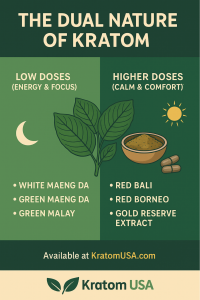 The duality of kratom’s effects comes from its complex alkaloid profile.
-
Mitragynine, abundant in all strains, tends to be stimulating and energizing.
-
7-Hydroxymitragynine, much rarer, contributes to relaxation and comfort.
In pharmacological terms, mitragynine acts as a partial mu-opioid receptor agonist while also influencing dopamine and adrenergic receptors, which regulate energy and motivation. This dual action explains how one plant can offer both stimulation and relaxation — depending on how it’s used.
No two strains or doses are identical. The way kratom is grown, harvested, and dried changes its alkaloid balance — and therefore, its effect profile.
🌿 Strain Colors and Their Roles
| Strain Color |
Primary Effects |
Best Time to Use |
| White Vein |
Energy, focus, motivation |
Morning / work hours |
| Green Vein |
Balance, mood, gentle clarity |
Midday or early afternoon |
| Red Vein |
Calm, relaxation, physical comfort |
Evening or before rest |
Users often rotate or blend strains to enjoy kratom’s full spectrum of effects — using white or green strains during the day and red at night for rest and recovery.
🧠 Kratom’s Built-In Balance
What makes kratom especially unique is its self-limiting nature. Because mitragynine and 7-hydroxymitragynine act only partially at receptor sites, kratom has a natural safety ceiling that prevents dangerous respiratory suppression — unlike synthetic drugs or opioids.
This built-in balance allows kratom to support energy, focus, and comfort within the body’s natural rhythms rather than overriding them.
🧪 Lab-Tested for Purity and Consistency
Every batch of kratom at KratomUSA undergoes independent third-party testing to verify:
-
Natural alkaloid levels for balanced effects.
-
Purity (free from additives, fillers, or synthetic alterations).
-
Absence of heavy metals or contaminants.
This ensures that you experience kratom’s natural dual nature — exactly as nature intended — with consistency and confidence.
💬 What Users Say
“I love that kratom can give me focus in the morning and relaxation at night. It’s the perfect balance.” — Hannah D.
“Green Maeng Da helps me through busy workdays, but Red Bali is my go-to for evenings. I can manage both energy and calm naturally.” — Tom R.
“It’s amazing that one plant can replace both coffee and my old sleep supplements.” — Lydia P.
❓ FAQ
Q: How can the same plant energize and relax?
A: Kratom’s alkaloids act differently at varying doses and receptor sites. Low doses boost alertness, while higher doses activate calming pathways.
Q: Does kratom affect everyone the same way?
A: No. Body chemistry, strain type, and dosage all play a role. It’s best to start small and adjust gradually.
Q: Is kratom safe?
A: When purchased from lab-tested, pure sources and used responsibly, kratom is considered safe and natural.
Q: Which strain offers the best balance?
A: Green strains (like Green Malay or Green Maeng Da) often provide both stimulation and relaxation.
🌿 Final Thoughts
Kratom’s dual nature is what makes it so unique — a plant capable of both uplifting the mind and soothing the body. Whether you need motivation to start the day or comfort to unwind at night, kratom provides a natural balance that adapts to your needs.
When sourced from trusted, lab-tested brands like KratomUSA, you can enjoy kratom’s versatility safely, confidently, and naturally.
Kratom isn’t just stimulating or relaxing — it’s both, depending on what your body needs most. 🌿
by KratomUSA | Oct 30, 2025 | Kratom
🌿 Understanding How Kratom Differs from Opioids
Kratom (Mitragyna speciosa) has become widely recognized for its potential to provide natural relief, focus, and calm — but unlike opioids, it does not suppress breathing.
This single fact makes kratom fundamentally different from traditional narcotics, and it’s one reason why many people turn to kratom as a natural alternative.
Let’s look at the science behind this distinction and what makes kratom’s active alkaloids so unique.
🔑 Key Points
-
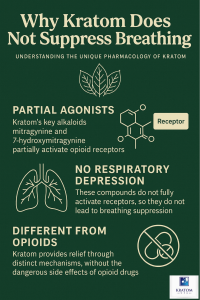
Kratom’s main alkaloids, mitragynine and 7-hydroxymitragynine, act as partial agonists, not full opioids.
-
They do not slow or suppress breathing, even at higher doses.
-
Opioids can cause respiratory depression by fully activating mu-opioid receptors in the brain.
-
Kratom’s partial receptor binding offers comfort and balance without the danger of respiratory shutdown.
-
Lab-tested kratom ensures natural alkaloid ratios and product purity.
🧬 The Science of Breathing and the Brain
 To understand why kratom doesn’t suppress breathing, it helps to know how respiratory depression occurs.
Your brainstem regulates breathing automatically. Opioids like morphine, fentanyl, and oxycodone fully activate mu-opioid receptors in this region. When that happens, the signal that tells your lungs to inhale and exhale becomes dangerously weak — this is what causes overdose-related deaths.
Mitragynine, kratom’s primary alkaloid, binds to some of these same receptors — but in a completely different way. It acts as a partial agonist, meaning it fits into the receptor but only triggers a mild response. The result is comfort and relief without shutting down the respiratory drive.
This unique pharmacological profile is what makes kratom fundamentally different from opioids, both in structure and in safety.
⚗️ How Kratom’s Alkaloids Work Differently
The two key alkaloids in kratom — mitragynine and 7-hydroxymitragynine — interact with the body in complex but gentle ways.
-
Mitragynine: The most abundant alkaloid (about 60–70% of kratom’s alkaloid content). It acts primarily on mu-opioid receptors, but it only partially activates them. It also affects adrenergic and serotonergic systems, helping balance energy and mood.
-
7-Hydroxymitragynine: Present in very small amounts (<0.02%), it’s more potent but short-acting. Even so, its concentration in natural kratom is too low to cause respiratory suppression.
Because these compounds do not fully activate opioid receptors, they cannot override the body’s natural breathing reflex. Studies show that even at high doses, mitragynine does not cause the same pattern of respiratory depression seen with drugs like heroin or oxycodone.
⚖️ Kratom vs. Opioids: The Key Differences
| Feature |
Kratom (Mitragynine) |
Opioids (Morphine, Fentanyl, etc.) |
| Receptor Type |
Partial mu-opioid receptor agonist |
Full mu-opioid receptor agonist |
| Effect on Breathing |
No respiratory suppression |
Can cause fatal respiratory depression |
| Source |
Natural plant (coffee family) |
Synthetic or poppy-derived |
| Overdose Risk |
Extremely low |
High |
| Common Use |
Natural wellness support |
Prescription or illicit pain relief |
In short, kratom’s action is modulating, not overpowering**.** It interacts with the body’s natural systems to support balance — rather than hijacking them.
🌿 Why “Partial Agonist” Matters
When a compound is a partial agonist, it produces limited activity at receptor sites. This means the body’s normal signals continue to function, including those that control breathing.
For example, buprenorphine — a medication used in opioid addiction recovery — is also a partial agonist. Like kratom, it provides relief without fully shutting down respiratory function.
This is a crucial distinction: kratom’s effects exist within a safety ceiling that prevents it from producing life-threatening breathing suppression.
🧪 Lab Testing: Ensuring Safe, Natural Ratios
Not all kratom is created equal. Alkaloid levels can vary depending on where and how the leaves are grown, dried, and processed.
That’s why third-party lab testing is essential.
At KratomUSA, every batch is:
-
Independently tested for mitragynine and 7-hydroxymitragynine content.
-
Verified for purity, ensuring no synthetic alteration or adulteration.
-
Screened for heavy metals and contaminants to guarantee safety.
Lab-tested kratom ensures you’re receiving natural alkaloid ratios exactly as nature intended — and peace of mind knowing your product is safe and transparent.
💬 What Real Users Say
“I started using kratom after prescription pain meds made me feel groggy. Kratom helped my pain but never affected my breathing or energy.” — Jamie P.
“It’s comforting to know kratom isn’t an opioid and that it’s tested for safety. It helps me relax naturally.” — Monica L.
“Kratom gave me relief without the scary side effects of prescription meds. It’s been a game changer.” — Ethan R.
❓ FAQ
Q: Why do some people confuse kratom with opioids?
A: Because it binds to some of the same receptors in the brain. But kratom’s alkaloids bind partially, not fully — meaning no respiratory suppression or overdose risk like opioids.
Q: Can kratom cause overdose?
A: Pure kratom has not been shown to cause fatal respiratory depression. Overdose reports are typically linked to adulterated or mixed products.
Q: Is kratom safe to use with other substances?
A: It’s safest to use kratom on its own. Mixing it with depressants like alcohol, opioids, or benzodiazepines increases risk.
Q: Does kratom affect everyone the same way?
A: No. Effects can vary by strain, dose, and body chemistry — but kratom’s natural alkaloids maintain a safety ceiling that helps prevent respiratory suppression.
🌿 Final Thoughts
Kratom’s ability to support comfort and calm without suppressing breathing is one of its most important distinctions from opioids. Its alkaloids — primarily mitragynine — interact gently and naturally with the body, creating balance rather than harm.
When used responsibly and purchased from lab-tested, verified sources like KratomUSA, kratom offers a safe, plant-based alternative that has stood the test of time.
Kratom isn’t an opioid — it’s a natural botanical with a complex chemistry designed to support wellness, not suppress life. 🌿